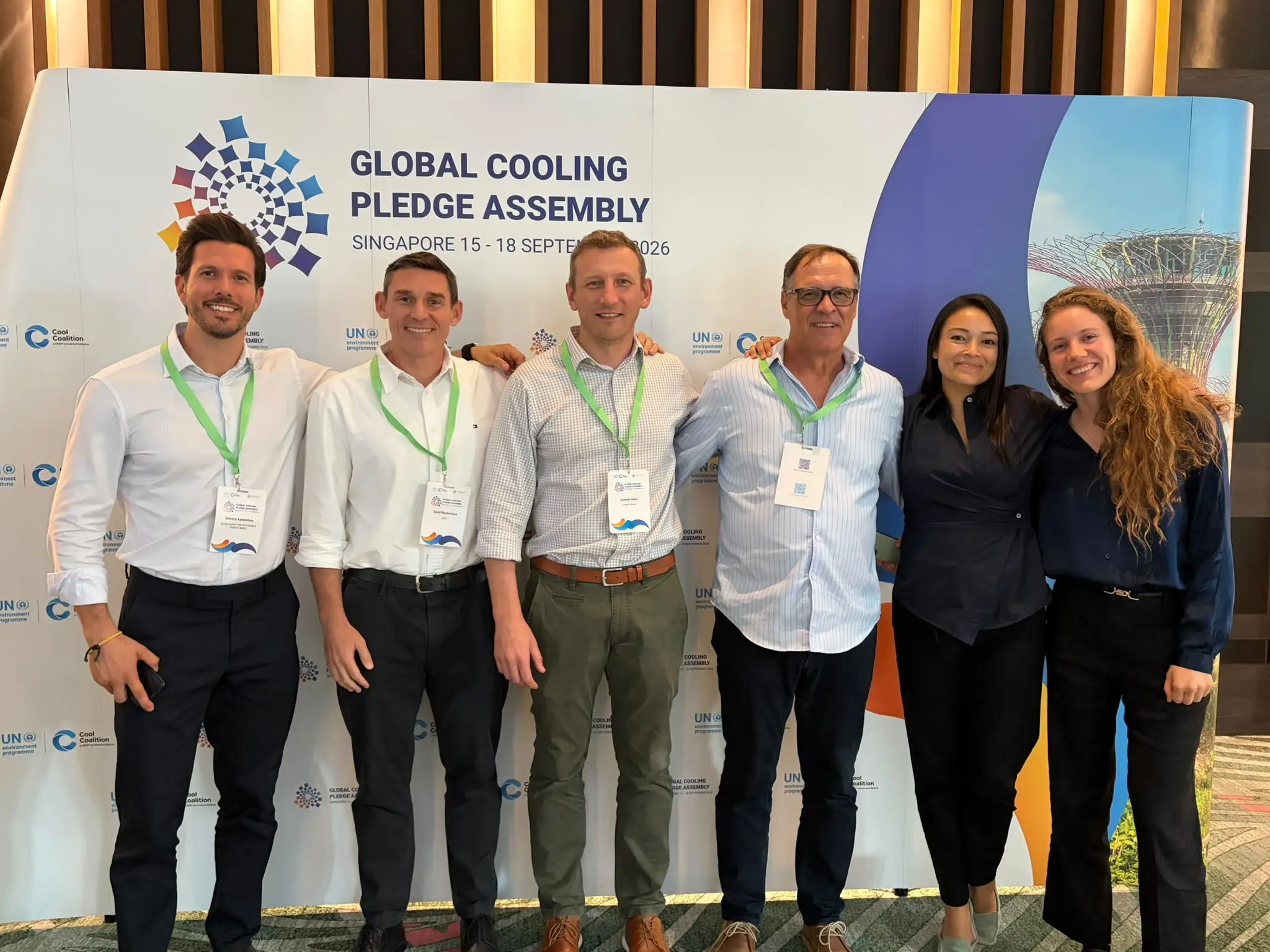
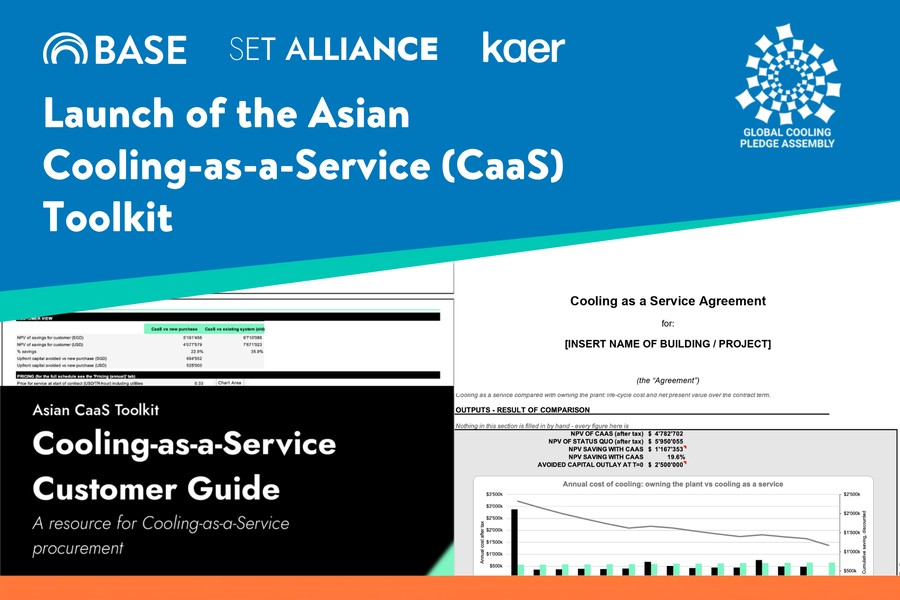
The global SET Alliance, an initiative founded by BASE Foundation and partners, has launched the Asian Cooling-as-a-Service (CaaS) Toolkit during Singapore’s Global Cooling Pledge Assembly 2026, which brings together Pledge signatory countries, cities, industry leaders, development finance institutions, and technical partners to accelerate the deployment of sustainable cooling and strengthen collaboration across the global cooling ecosystem. The toolkit provides practical guidance on how to structure and evaluate CaaS projects, created in collaboration with industry partner Kaer, a pioneer of CaaS active across Southeast Asia and India.
Global demand for cooling is growing rapidly across Asia Space cooling consumes roughly 10% of the world’s electricity. Most buildings rely on the traditional purchasing model, buying a chiller plant outright and maintaining it to ensure acceptable performance for as long as possible. As new systems get more efficient and shift to natural or low-GWP refrigerants, they become more complex and expensive.
Cooling-as-a-Service (CaaS) removes the upfront cost for the customer and shifts operation, maintenance and performance responsibilities to a dedicated provider. Under CaaS, instead of buying the equipment, a client can pay for the cooling it uses, against agreed performance targets. The provider designs, finances, installs, owns, operates and maintains the plant for the length of the contract.
Cooling-as-a-Service providers are present in Singapore, India, Malaysia, Indonesia, and Vietnam with impactful projects reducing and optimising energy use as well as contributing to Green Building certification. Making it work in practice, at scale, across a region where laws, currencies and climates differ by country, requires significant adaptation work.
BASE Foundation, through the SET Alliance, is launching the Asian CaaS Toolkit, a set of documents to support the market adoption of Cooling-as-a-Service.
Why a toolkit?
The toolkit is designed to be a foundation for understanding CaaS for actors across the building and real estate value chain. For facility managers, building owners, procurement officers and consultants, there is currently no standard way of requesting or evaluating bids and a lack of guidance on how to understand commercial proposals. The Asian CaaS toolkit features 1) the Customer Guide and Request for Quotation template, which outlines the procurement process and includes relevant information on pricing, risk allocation, and evaluating proposals; 2) the Standardised CaaS Contract, complete with explanatory notes on key areas; Customer Review tool, to compare the CaaS model and the traditional model consisting in buying and owning the equipment; 4) the Economic & Pricing Model, a financial modelling tool that explores lifecycle cost comparison of CaaS against outright equipment purchases and status quo legacy maintenance.
Who is the toolkit for?
Facility owners and their advisors (e.g., commercial building owners, mall operators, hospital administrators, data centre and industrial plant managers) can use the toolkit to request competitive bids without committing capital upfront, to compare CaaS proposals against a conventional purchase on the same cost basis, and to adequately address risk to protect their operations.
Technology and service providers (e.g., chiller manufacturers, energy service companies, specialised cooling operators) can work from clear scoping definitions, understand what is expected in a request for quotation, and explore pricing for CaaS.
Financiers and capital providers (e.g., commercial banks, special purpose vehicles, infrastructure and impact funds) can explore assumptions under CaaS as a financing structure, lowering perceived risk.
The first CaaS Toolkit built for regional conditions
The toolkit’s technical and legal content is designed to support CaaS project development in commercial and industrial sectors. The contract comes with a checklist that considers adaptation to the specific national laws. Prices adjust automatically over time to reflect changes in energy costs, water costs and general inflation. The toolkit also fits with rules already in place across the region, including Singapore’s Green Mark and Malaysia’s Green Building Index certifications, as well as the international rules phasing out harmful refrigerants.
Launching in Singapore
The SET Alliance released the toolkit during the Global Cooling Pledge Assembly, convened by the UNEP Cool Coalition in Singapore, which included a site visit for participants to KAER’s CaaS plant at Chinatown Point, as well as a masterclass on Cooling-as-a-Service. The Toolkit was also featured as part of a private sector event organised by Kaer focused on the development of CaaS in the region which was attended by key stakeholders.